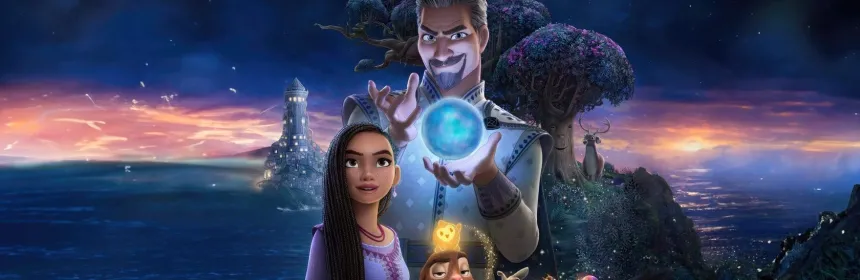
Many went into Wish (2023) expecting a triumphant return to classic Disney storytelling, a pure 2D-esque celebration for the studio’s 100th anniversary. It’s easy to assume this film would be a comforting, familiar hug. The truth is, Wish is a much more complex, and often divisive, viewing experience. It tries to bridge the past and present of Disney animation, leading to moments of true magic alongside noticeable stumbles.
The Story’s Core Promise and Its Delivery
At its heart, Wish explores the power of wishes, a concept foundational to Disney’s entire legacy. The film introduces us to Asha, a bright and quick-witted 17-year-old living in the kingdom of Rosas, an island ruled by the charming and powerful King Magnifico. Magnifico has the unique ability to grant wishes, but with a significant catch: he collects them from his citizens, holding them in suspended animation until he deems one worthy of granting. This premise sets up a fascinating conflict, pitting individual hope against benevolent control.
Asha’s journey begins when she discovers Magnifico’s true intentions—he rarely grants the wishes, fearing their potential. This revelation sparks her own wish, a desperate plea to the stars that summons a magical, silent companion named Star. Star is pure, unadulterated joy, a beacon of light that helps Asha awaken the wishes of Rosas. The narrative leans heavily on this central conflict, pushing Asha to become a leader and ignite a rebellion against a king who started with good intentions but became corrupted by power and fear. The concept is strong, yet its execution feels somewhat rushed at times, preventing a deeper exploration of the ethical dilemmas it presents.
Asha’s Journey and Motivation
Asha stands as a compelling protagonist, driven by genuine empathy for her community. Her motivation isn’t selfish; it stems from seeing her grandfather’s unfulfilled wish and the collective longing of Rosas. The moment she confronts King Magnifico and realizes the true nature of his wish-holding ritual is powerful. This turn forces her hand, transforming her from an aspiring apprentice into a reluctant but determined revolutionary. Her connection with Star, while largely non-verbal, provides much of the film’s emotional warmth. We see her grow from a hopeful applicant to a brave leader, unafraid to challenge authority for the greater good of her people.
King Magnifico: A Villain with Nuance?
King Magnifico begins as a genuinely charismatic and seemingly benevolent ruler. He established Rosas as a safe haven, and his ability to grant wishes appears selfless. However, his descent into villainy happens quite swiftly. His paranoia about “dangerous” wishes and his increasing desire for total control over his citizens’ dreams quickly overshadow his initial charm. While the film attempts to give him a sympathetic backstory, implying his own past trauma with unfulfilled wishes, it doesn’t quite fully land. This prevents him from becoming a truly complex antagonist like a Scar or Frollo. Instead, he transforms into a more straightforward, albeit entertaining, power-hungry sorcerer.
The Wish Concept: What Does It Really Mean?
The film grapples with the philosophical implications of wishes. Is a wish something to be granted, or a personal drive that motivates us? Magnifico’s system removes personal agency, while Asha champions the idea that wishes are part of who we are, not something to be controlled. This thematic exploration is perhaps the most profound aspect of Wish. It encourages viewers to reflect on their own aspirations and the courage it takes to pursue them independently. The movie argues for the innate power of individual hope and ambition, rather than relying on an external force to fulfill dreams. This message resonates deeply with Disney’s historical celebration of individual spirit.
Animation Style: A Blended Approach
Wish makes a bold visual statement, aiming to honor Disney’s hand-drawn past while embracing its modern CG capabilities. It’s not a pure 2D film, nor is it strictly 3D. Instead, it attempts a stylistic blend, particularly noticeable in its character designs and background art. This choice has proven to be one of the most talked-about aspects of the film, and not always for positive reasons. It’s a risk, trying to evoke nostalgia without fully committing to it.
| Feature | Wish Approach | Classic 2D Comparison (e.g., Cinderella) | Modern 3D Comparison (e.g., Frozen) |
|---|---|---|---|
| Character Design | CG models with hand-drawn line work and exaggerated proportions, aiming for a storybook feel. | Purely hand-drawn, expressive lines, traditional ink and paint. | Smooth, realistic CG models, detailed textures, naturalistic movement. |
| Backgrounds | Watercolor-inspired textures, painterly brushstrokes, giving depth and artistic flair. | Intricate, multi-plane painted backdrops, often highly detailed and atmospheric. | Fully rendered 3D environments, complex lighting, photorealistic elements. |
| Visual Effects | Digital effects with a cel-shaded quality, mimicking classic animation effects (e.g., Star’s glow, magic). | Hand-drawn effects, often rotoscoped or animated frame-by-frame (e.g., fairy dust, transformations). | Advanced particle systems, volumetric lighting, highly realistic simulations (e.g., Elsa’s ice powers). |
| Overall Aesthetic | A unique hybrid; some find it charmingly nostalgic, others perceive it as visually inconsistent. | Timeless, fluid, organic, with a focus on artistic craft and expressive motion. | Contemporary, immersive, technologically advanced, with a focus on realism and dynamic camera work. |
The visual blend is an ambitious creative decision. On one hand, the watercolor backgrounds are often breathtaking, adding a warmth and texture that feels genuinely unique. Star, with its expressive, glowing form, feels like a direct homage to classic animated effects. On the other hand, the character animation, while attempting to capture the squash-and-stretch of 2D, sometimes falls into an uncanny valley for viewers accustomed to either pure 2D or seamless 3D. The intention was to create something new that honored the past, but the execution can feel like a compromise rather than a definitive new style. It requires a specific viewing lens to appreciate its artistic ambition fully.
Musical Numbers: Hits and Misses
No Disney animated film is complete without its songs, and Wish delivers a soundtrack penned by Julia Michaels and Benjamin Rice. The score attempts to capture both the grandeur of classic Disney musicals and the contemporary pop sensibilities often found in recent films. The results are a mixed bag, with some tracks shining brightly and others fading into the background.
- “Welcome to Rosas”: This opening number sets the stage, introducing the utopian kingdom and King Magnifico’s benevolent (at first) rule. It’s catchy and establishes the world, but doesn’t quite have the immediate “earworm” quality of other Disney openers.
- “This Wish”: Asha’s “I Want” song is arguably the film’s standout. Sung with passion by Ariana DeBose, it’s an emotional and soaring ballad that truly captures the yearning and hope central to the story. It feels like a classic Disney anthem, delivering on the promise of a powerful wish.
- “I’m a Star”: This ensemble number, performed by the forest creatures and ultimately the entire kingdom, is full of joy and light. It’s a celebration of individual brilliance and the interconnectedness of all living things, but lyrically, it occasionally veers into the overly simplistic, feeling a bit generic.
- “This Is The Thanks I Get?!”: King Magnifico’s villain song is a highlight for its theatricality and Chris Pine’s charismatic vocal performance. It’s a deliciously self-aware tune, showcasing Magnifico’s growing ego and entitlement. It’s memorable for its comedic timing and Pine’s delivery, even if it doesn’t delve into the deepest psychological depths.
- “Knowing What I Know Now”: A more reflective, empowering song for Asha as she commits to her fight. It’s a solid character development piece but lacks the immediate hook of “This Wish.”
Overall, while “This Wish” and Magnifico’s villain song are strong contenders for replay value, the rest of the soundtrack struggles to reach the iconic status of past Disney hits. The songs serve the story well, moving the plot and characters forward, but few will likely join the pantheon of truly unforgettable Disney tunes. The lyrical depth is sometimes sacrificed for broader appeal, which makes some numbers feel less impactful.
Character Development: Beyond Asha and Magnifico
While Asha and King Magnifico dominate the narrative, Wish features a colorful ensemble. However, the depth given to these supporting players varies. The film’s desire to incorporate numerous Easter eggs and references to past Disney characters sometimes overshadows the development of its own new cast.
What about the supporting characters?
Asha’s friends, particularly Dahlia and Gabo, provide comic relief and moral support. Dahlia, the baker, is loyal and warm, while Gabo, the cynic, offers a contrasting viewpoint. Each of Asha’s seven friends is loosely inspired by the Seven Dwarfs, which is a clever nod but also means they are often archetypes rather than fully fleshed-out individuals. They serve their purpose in advancing Asha’s journey and providing ensemble moments, but their personal arcs are minimal. You see glimpses of their personalities, but not enough to truly invest in them individually. This makes them feel more like supporting players in a grander narrative rather than essential, distinct characters.
Does Star carry enough emotional weight?
Star, the physical embodiment of a fallen star, is pure, unadulterated cuteness. It communicates through expressive movements and charming sounds, becoming Asha’s loyal sidekick. While Star is undeniably endearing and a fantastic visual presence, its silent nature means it relies entirely on its animation to convey emotion and impact. For some, Star is a magical marvel; for others, its lack of dialogue limits its emotional resonance. It’s a powerful symbol of hope and innocent magic, but it doesn’t undergo a significant character journey itself, serving more as a catalyst and companion for Asha.
Are the Easter Eggs distracting?
Wish is absolutely packed with references to Disney’s past films, from character names to visual nods and musical motifs. While these Easter eggs are clearly intended as a loving tribute to 100 years of animation, they can sometimes be distracting. For eagle-eyed fans, spotting every reference becomes a game, but for general audiences, these frequent callbacks might pull them out of the film’s original story. They serve as a constant reminder of other, perhaps more beloved, Disney films, which can inadvertently highlight what Wish might be lacking in terms of its own fresh identity. It’s a fine line between homage and overwhelming the narrative, and Wish occasionally steps over it.
The Pacing Problem: A Rush to the Finish
The film struggles significantly with its rhythm, rushing through key emotional beats and character transformations. This uneven pacing prevents some of the more impactful moments from truly landing, leaving viewers feeling like certain plot points were glossed over. The setup for Rosas and Asha’s initial relationship with Magnifico feels solid, but once the conflict ignites, the narrative accelerates, sometimes to its detriment. Key turning points, especially Magnifico’s descent into full villainy and the kingdom’s awakening, happen quite suddenly, minimizing the emotional build-up.
This quickened pace affects character development, leaving less room for the audience to fully grasp the internal struggles or evolving motivations. We are told about the stakes, but not always given the time to truly feel them. The desire to move from one plot point to the next, perhaps to fit within a specific runtime, means that some of the narrative’s potential depth is left unexplored. A more deliberate pace could have allowed for greater emotional resonance and a more satisfying arc for both hero and villain.
The Speed of Asha’s Revelation
Asha’s realization of Magnifico’s true colors, while a pivotal moment, feels somewhat abrupt. Her immediate leap from hopeful apprentice to full-blown rebel happens within a short span, limiting the exploration of her internal conflict and the gravity of her decision. The film could have benefited from a slightly longer period where Asha grapples with this moral dilemma, making her eventual stand feel more earned and impactful. Instead, it feels like a necessary plot point to move the story forward, rather than a deep, personal transformation.
Magnifico’s Swift Descent
King Magnifico’s transformation from a well-intentioned, if misguided, ruler into a power-hungry sorcerer also feels truncated. His early charm gives way to overt villainy very quickly, driven by paranoia that escalates without extensive explanation. While his villain song provides some insight into his ego, the narrative doesn’t fully explore the psychological triggers or the slow, corrupting influence of power. This rapid shift makes him a less nuanced villain than he could have been, reducing him to a more generic antagonist rather than a complex figure whose fall from grace could have been truly tragic.
Is It a True 100th Anniversary Celebration?
Wish clearly aims to be a grand celebration of Disney’s century-long legacy. It’s packed with visual and thematic nods to beloved films and characters, serving as a love letter to the studio’s history. However, its own unique identity sometimes gets lost amidst the constant callbacks. While a charming and heartfelt effort, it doesn’t quite achieve the iconic status or groundbreaking innovation one might hope for in a film marking such a significant milestone. It’s a respectful tribute, but perhaps not the definitive statement many had anticipated.
Who Should Watch Wish (and Who Might Be Disappointed)
Understanding what Wish offers can help set expectations, a long-time Disney fan or just looking for a new family film. It’s not a universal crowd-pleaser in the way some Disney classics are, but it definitely has its merits for the right audience. Here’s a quick guide to help you decide.
- Tip 1: Approach it as a unique blend, not a pure classic callback. Don’t go in expecting pure 2D or a direct replica of the Golden Age. Embrace the experimental animation style and narrative choices.
- Tip 2: Look for the artistic ambition in the animation. Pay attention to the watercolor textures in the backgrounds and the deliberate choices made to blend 2D and 3D. There’s a lot of craft to appreciate if you know what to look for.
- Tip 3: Manage expectations for the villain’s depth. King Magnifico is entertaining, but he’s not a complex, morally grey antagonist. Enjoy his charisma for what it is.
- Tip 4: Enjoy the vocal performances. Ariana DeBose and Chris Pine bring significant talent to their roles, elevating the characters even when the script sometimes falls short.
- Tip 5: For die-hard traditionalists, be prepared for modern elements. While it nods to the past, Wish is still a contemporary Disney film with modern pacing and sensibilities.
For Younger Viewers
Younger children will likely adore Wish. Star’s playful antics, the vibrant colors, and Asha’s heroic journey are all highly engaging for a younger audience. The themes of hope and standing up for what’s right are clear and inspiring. The songs are catchy enough for kids to enjoy, and the overall message is uplifting. This film feels tailor-made to delight those experiencing Disney magic for the first time, without the baggage of comparing it to a century of films.
For Long-Time Disney Fans
Long-time Disney fans might have a more mixed reaction. The film’s constant Easter eggs are a delightful game for those who know their Disney history inside and out. However, the blended animation style and the occasionally rushed pacing might not sit well with purists who yearn for a return to specific eras of animation. If you approach Wish as a respectful, yet experimental, anniversary film rather than a flawless masterpiece, you’re more likely to find enjoyment in its unique vision and heartfelt moments. It’s an interesting piece in the evolving tapestry of Disney’s storytelling.
Ultimately, Wish is a testament to Disney’s ongoing attempt to redefine its narrative and visual identity while honoring its immense legacy. The journey of Disney animation continues to be one of adaptation and reinvention, constantly seeking new ways to tell timeless stories. While Wish may not be a perfect film, it offers a fascinating glimpse into where the studio might be heading next—a future where tradition and innovation constantly collide.